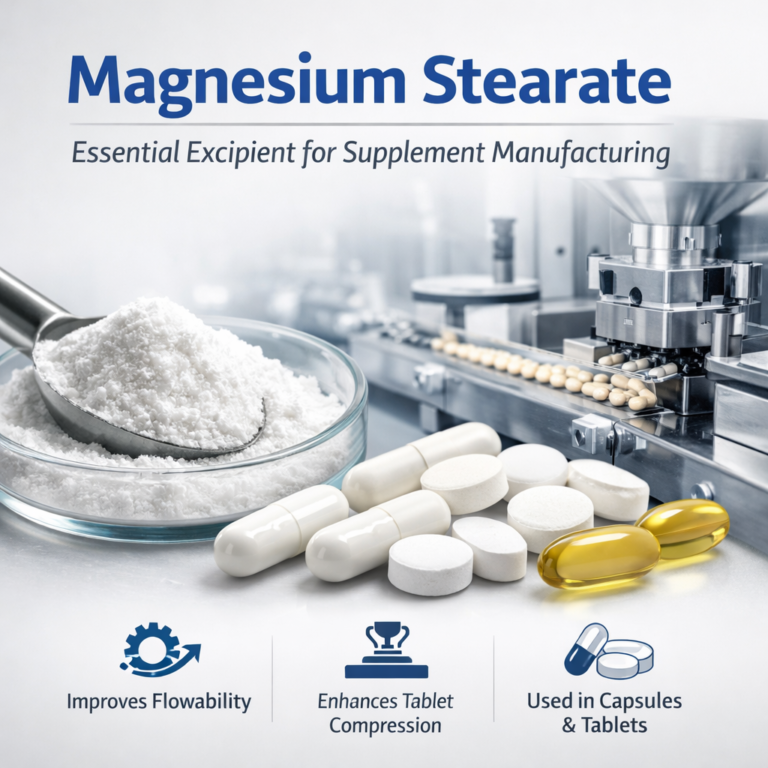
[Featured Image Suggestion]
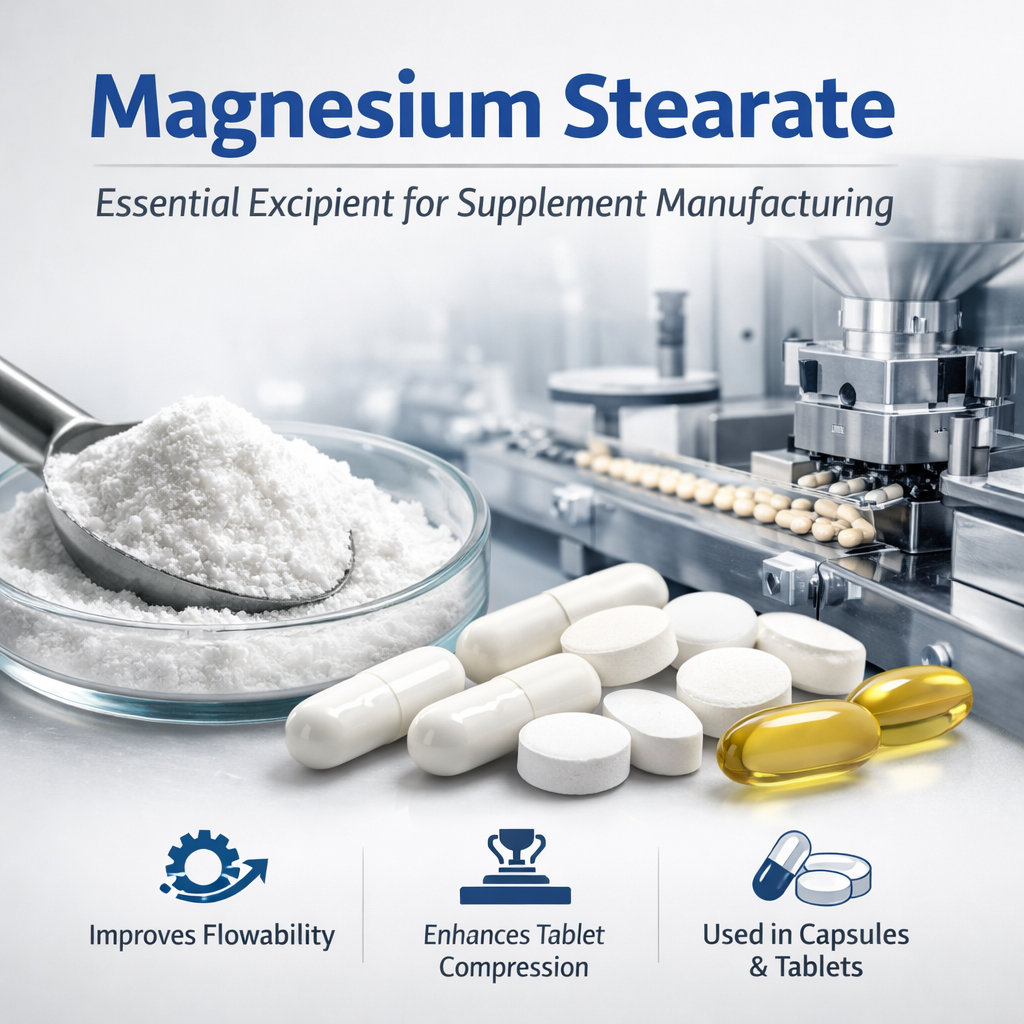
A clean visual showing white magnesium stearate powder next to capsule and tablet production equipment — this highlights its technical role in manufacturing dietary supplements and some food products.
Leading Paragraph (PAS Formula)
When food and supplement formulators design products for global markets, ingredient safety and regulatory compliance are top priorities. Many consumers pay close attention to labels, and unfamiliar additives can raise questions. One of the most common excipients used in supplements and some food products is magnesium stearate. Despite its frequent appearance in the ingredient list, many buyers don’t fully understand what it does or how it affects product safety and performance.
Concerns about additives often lead to confusion about whether they pose health risks or compromise product quality. Without clear information, brands may hesitate to use ingredients that could benefit production efficiency and consistency.
The good news is that magnesium stearate has a long track record of safe use when applied correctly. In this article, U will learn what magnesium stearate is, why it’s widely used, how regulators treat it, and what manufacturers need to know about safety and best practices.
Snippet Paragraph (Featured Snippet Target)
Magnesium stearate is a white powder used as a flow agent, lubricant, and anti-adherent in supplement and food manufacturing. It helps powders move smoothly during tablet and capsule production, prevents sticking, and improves manufacturing consistency. Regulatory authorities such as the FDA generally recognize magnesium stearate as safe (GRAS) when used at typical low levels (usually less than 1% of the product). It is not a source of significant nutrition and is unlikely to cause harm at normal intake levels. :contentReference[oaicite:0]{index=0}
Transition Paragraph
Before choosing ingredients for your next product, it helps to understand both the functional purpose and safety profile of magnesium stearate in a clear, fact-based way. Let’s dive into its role, regulatory acceptance, and what science says about safety.
Table of Contents
- What Is Magnesium Stearate?
- Why Is It Used in Supplements and Foods?
- How Do Regulators Classify Magnesium Stearate?
- Safety Profile and Common Concerns
- Alternatives to Magnesium Stearate
- How to Identify It in Product Labels
1. What Is Magnesium Stearate?
Opening Paragraph
Magnesium stearate is a dry, white powder formed from magnesium and stearic acid. Despite containing magnesium, it is not considered a magnesium supplement because it provides negligible nutritional magnesium. Instead, it’s an inactive ingredient — often classified as an excipient in supplement and pharmaceutical production. :contentReference[oaicite:1]{index=1}
Snippet Paragraph
It is a common additive used to improve powder flow and prevent sticking in tablet and capsule production. :contentReference[oaicite:2]{index=2}
[Sub-heading Featured Image Suggestion]
Close-up of white magnesium stearate powder beside raw stearic acid sources (e.g., palm oil or stearic acid flakes).
Deep Dive Paragraph
Chemically, magnesium stearate is the magnesium salt of stearic acid, a long-chain fatty acid found naturally in many foods like cocoa butter, meat, and dairy. :contentReference[oaicite:3]{index=3} Stearic acid itself is a common saturated fat that does not raise cholesterol levels like other saturated fats. :contentReference[oaicite:4]{index=4} When combined with magnesium, it becomes a lubricating, flow-enhancing powder used during manufacturing.
Claims:
- Magnesium stearate is made from magnesium and stearic acid.
- It does not contribute significant nutritional magnesium.
2. Why Is It Used in Supplements and Foods?
Opening Paragraph
Magnesium stearate’s primary role is technical, not nutritional. Its physical properties make it extremely useful in production, especially for solid-dose products like tablets and capsules.
Snippet Paragraph
It serves as a flow agent, lubricant, and anti-caking agent, improving manufacturing efficiency and product uniformity. :contentReference[oaicite:5]{index=5}
[Sub-heading Featured Image Suggestion]
Tablet press machine with flowing powder.
Deep Dive Paragraph
In supplements, magnesium stearate serves several functions:
- Flow agent: Helps powders move smoothly through hoppers and machinery. :contentReference[oaicite:6]{index=6}
- Lubricant: Reduces friction between particles and equipment, preventing sticking. :contentReference[oaicite:7]{index=7}
- Anti-caking: Keeps powders from clumping, which improves consistency during production. :contentReference[oaicite:8]{index=8}
In food products, it can act as an anti-caking or flow-enhancing agent in spices, baking ingredients, chewing gum, and confectionery. :contentReference[oaicite:9]{index=9}
Claims:
- Magnesium stearate improves manufacturing efficiency.
- It helps maintain product consistency.
3. How Do Regulators Classify Magnesium Stearate?
Opening Paragraph
Regulatory acceptance is a cornerstone of safety evaluation for food and supplement ingredients. Magnesium stearate has been reviewed and approved for use in multiple jurisdictions.
Snippet Paragraph
The U.S. Food and Drug Administration (FDA) designates magnesium stearate as Generally Recognized as Safe (GRAS) for use in foods and supplements. :contentReference[oaicite:10]{index=10}
[Sub-heading Featured Image Suggestion]
FDA GRAS documentation or a regulatory compliance visual.
Deep Dive Paragraph
Globally, magnesium stearate is included on approved additive lists and is permitted in foods and dietary supplements at typical low usage levels. Organizations like the WHO and JECFA recognize its safety in the context of normal use. :contentReference[oaicite:11]{index=11} Because it is not intended to provide nutritional value, regulatory bodies treat it as a processing aid rather than a nutrient.
Claims:
- It is accepted by major regulators as safe at normal use levels.
- It is not a nutrient ingredient but a functional excipient.
4. Safety Profile and Common Concerns
Opening Paragraph
Safety concerns about magnesium stearate often arise from online rumors or misinterpretations, but the scientific evidence supports its safety when consumed at typical levels found in supplements and foods.
Snippet Paragraph
Typical usage levels in supplements are low (often <20 mg per serving) and are well below amounts linked to adverse effects. :contentReference[oaicite:12]{index=12}
[Sub-heading Featured Image Suggestion]
Visual of a digestive system and tablet dissolution.
Deep Dive Paragraph
Most people tolerate magnesium stearate without issues. Some rare concerns include:
- Laxative effect or mild gut discomfort at very high doses, consistent with fat intake. :contentReference[oaicite:13]{index=13}
- Allergic sensitivity in extremely rare cases; this is usually individual and not common. :contentReference[oaicite:14]{index=14}
Scientific studies show magnesium stearate has no genotoxicity and does not pose cancer risk at typical exposures. :contentReference[oaicite:15]{index=15} Many speculative online claims — such as immune suppression, nutrient absorption interference, or “biofilm” formation — are not supported by robust evidence. :contentReference[oaicite:16]{index=16}
Claims:
- No strong scientific evidence links magnesium stearate to serious health problems.
- Occasional sensitivities are possible but rare.
5. Alternatives to Magnesium Stearate
Opening Paragraph
Some formulators prefer alternatives, especially when designing products for niche markets that avoid certain excipients.
Snippet Paragraph
Alternatives like calcium stearate, hydrogenated castor oil, or sodium lauryl sulfate can replace magnesium stearate in some formulations but may have different functional profiles. :contentReference[oaicite:17]{index=17}
[Sub-heading Featured Image Suggestion]
Visual comparison of excipient alternatives.
Deep Dive Paragraph
Switching excipients can influence how powders flow and compress, so formulators must weigh manufacturing trade-offs. Not all alternatives provide the same lubricating efficiency or processing benefits, which is why magnesium stearate remains widely used.
Claims:
- Alternatives exist but may change manufacturing behavior.
- Each option requires careful formulation evaluation.
6. How to Identify It in Product Labels
Opening Paragraph
If you want transparency in your products, knowing how magnesium stearate is listed helps buyers, formulators, and quality teams.
Snippet Paragraph
Look for magnesium stearate under “Other Ingredients” or “Inactive Ingredients” on supplement and food labels. :contentReference[oaicite:18]{index=18}
[Sub-heading Featured Image Suggestion]
Close-up of a supplement label showing magnesium stearate in the ingredient list.
Deep Dive Paragraph
Magnesium stearate may also appear under alternative names such as magnesium distearate, magnesium octadecanoate, or octadecanoic acid (magnesium salt). Checking labels helps you communicate clearly with consumers and maintain ingredient transparency.
Claims:
- Proper labeling supports consumer trust.
- Knowing synonyms improves product clarity.
Conclusion
Magnesium stearate is a widely used excipient in dietary supplements and some food products. Its role as a flow agent and lubricant helps ensure consistent manufacturing and quality, and global regulators generally recognize it as safe at typical use levels. Scientific evidence does not support many of the exaggerated concerns found online. While rare sensitivities may occur, overall safety data show it to be a practical and low-risk ingredient when used as intended.
Contents of Conclusion
- Magnesium stearate is a functional excipient, not a nutrient.
- It improves manufacturing performance.
- Regulators classify it as safe at normal use.
- Rare sensitivities are possible, but serious risks lack evidence.
SEO Keywords
- magnesium stearate safe
- magnesium stearate in supplements
- magnesium stearate food additive
Meta Description (≤160 characters):
Learn if magnesium stearate is safe in supplements and foods, how it works as a flow agent, and what science and regulators say about its safety.
Promotional Copy for Your Company
When you need consistent, high-quality magnesium stearate for supplements or functional foods, our factory delivers reliable material with stable performance. Produced under strict quality controls, our magnesium stearate supports smooth manufacturing, uniform dosing, and regulatory compliance. Partner with us for dependable supply and technical guidance that helps your products perform at the highest level.