Pharmaceutical formulation is not just about active ingredients — it’s about how effectively a tablet or capsule delivers them. Inconsistent disintegration, poor flowability, or weak tablet strength can turn a great formulation into an unstable product. That’s where Microcrystalline Cellulose (MCC) steps in. This multifunctional excipient ensures every tablet maintains uniformity, stability, and reliability. Across the global pharmaceutical industry, MCC has become a silent yet indispensable component that enables smooth production and consistent drug performance. Understanding its role reveals why nearly every pharmaceutical company relies on it today.
Microcrystalline Cellulose (MCC) plays a crucial role in the pharmaceutical industry as a binder, filler, and disintegrant. It improves tablet strength, enhances flowability, and ensures uniform distribution of active ingredients. Due to its chemical stability, compressibility, and inertness, MCC is one of the most commonly used excipients in tablets, capsules, and other solid dosage forms.
To fully understand why MCC is so widely used, it’s important to look at its properties, functions, and benefits from a technical and practical pharmaceutical perspective.
1. What Is Microcrystalline Cellulose (MCC)?
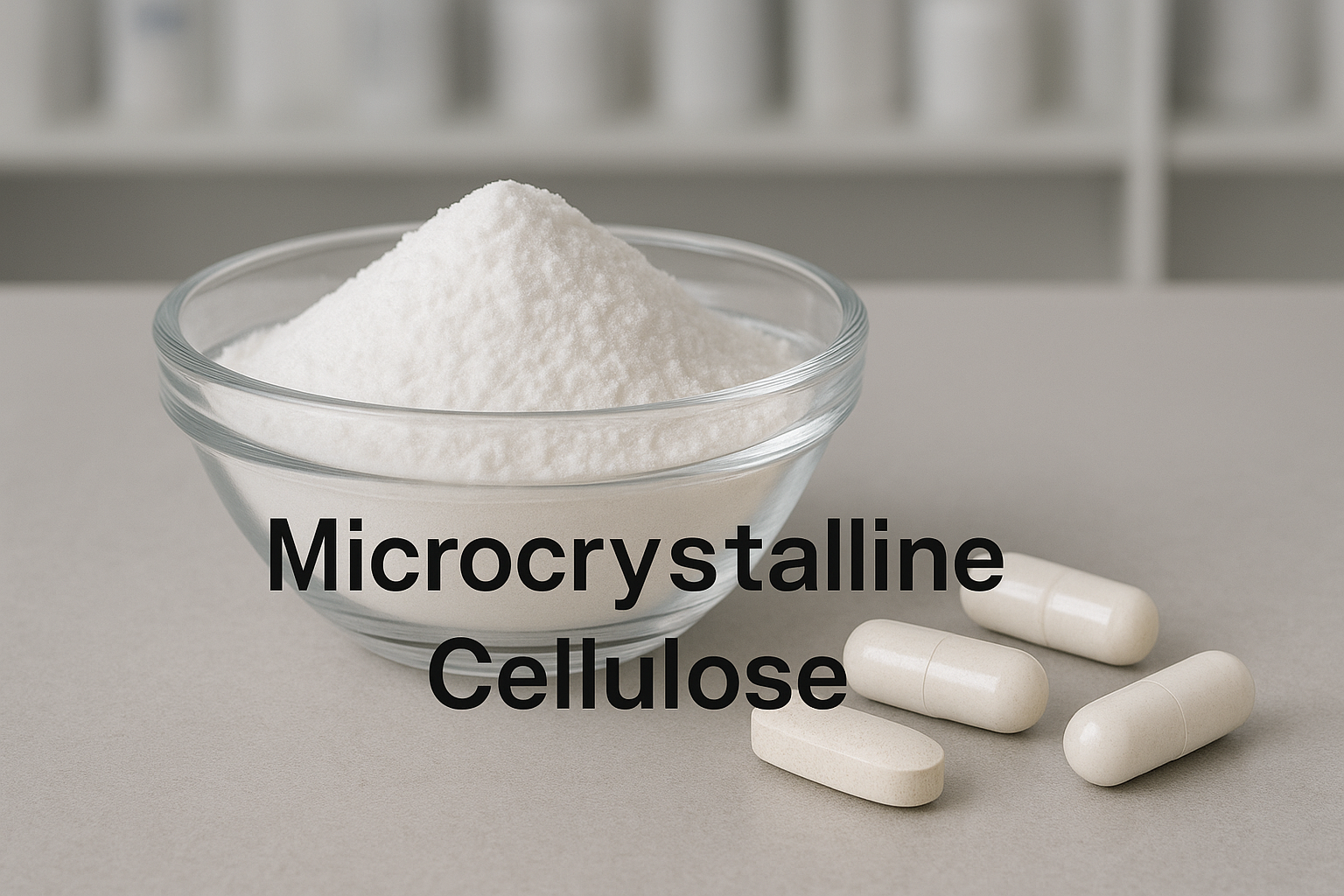
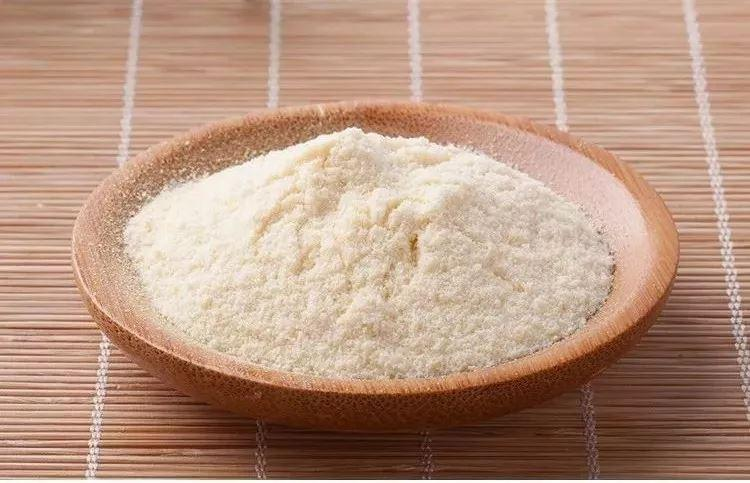
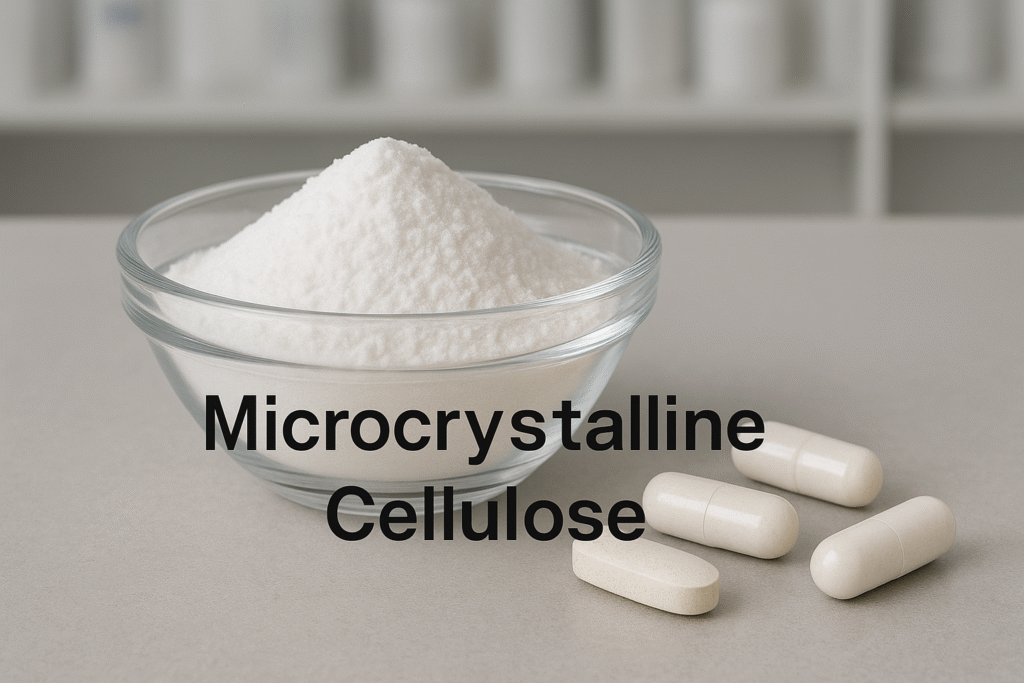
Microcrystalline Cellulose (MCC) is a purified, partially depolymerized cellulose derived from plant fibers, commonly wood pulp. It appears as a white, free-flowing powder with excellent compressibility and binding properties, making it ideal for solid dosage formulations.
In the pharmaceutical industry, MCC serves as an inert, non-reactive excipient that forms the backbone of tablet and capsule production.
The structure of MCC consists of crystalline regions that provide mechanical strength. It is insoluble in water but swells upon contact, helping tablets disintegrate efficiently after ingestion.
| Property | Description |
|---|---|
| Origin | Purified cellulose from plant pulp |
| Appearance | White crystalline powder |
| Solubility | Insoluble in water and most solvents |
| Role | Binder, filler, disintegrant |
- MCC offers excellent compressibility for direct compression tablets.
- MCC maintains formulation stability across temperature and humidity variations.
Why Is MCC Essential in Pharmaceutical Manufacturing?
MCC’s multifunctional characteristics make it a critical raw material in modern pharmaceutical manufacturing. It simplifies the production process and improves tablet performance.
Pharmaceutical companies use MCC because it provides a consistent and reliable base for producing tablets and capsules with uniform weight and hardness.
MCC enables direct compression — a cost-effective method that eliminates the need for granulation.
| Manufacturing Aspect | MCC Function |
|---|---|
| Tablet Formation | Enhances compressibility |
| Flow Properties | Improves powder uniformity |
| Stability | Reduces segregation risk |
- MCC simplifies large-scale tablet production with stable performance.
- MCC improves flow and reduces dust formation in automated lines.
How Does MCC Function in Tablet Formulation?
In tablet formulation, MCC plays multiple roles simultaneously. Its physical structure allows tablets to form under pressure while still disintegrating effectively inside the body.
MCC acts as a binder to hold ingredients together, a filler to add bulk, and a disintegrant to promote quick tablet breakdown.
| Function | Mechanism | Result |
|---|---|---|
| Binder | Deforms under pressure | Strong, cohesive tablets |
| Filler | Provides uniform mass | Consistent tablet weight |
| Disintegrant | Swells in water | Rapid dissolution and absorption |
- MCC ensures controlled disintegration and optimal bioavailability.
- MCC maintains uniform distribution of APIs in every tablet.
What Are the Key Benefits of MCC in Pharmaceuticals?
The versatility of MCC offers both manufacturing and product performance advantages.
Its benefits include excellent compressibility, uniform mixing, chemical stability, and compatibility with a wide range of active pharmaceutical ingredients (APIs).
| Benefit | Description |
|---|---|
| High Compressibility | Enables direct compression |
| Uniform Blending | Prevents segregation of ingredients |
| Chemical Stability | Inert to moisture and pH |
| Global Compliance | Meets USP, BP, EP standards |
- MCC improves production efficiency and product consistency.
- MCC supports clean-label formulations due to its plant-based origin.
How Does MCC Compare with Other Excipients?
While many binders and fillers exist, MCC remains the gold standard in pharmaceutical formulations due to its balance of functionality and safety.
Compared to lactose, starch, or dicalcium phosphate, MCC provides better compressibility and disintegration without requiring additional additives.
| Excipient | Compressibility | Disintegration | Chemical Stability |
|---|---|---|---|
| MCC | Excellent | Fast | High |
| Lactose | Good | Moderate | Medium |
| Starch | Average | Good | Variable |
| DCP | Weak | Poor | Good |
- MCC provides optimal performance for direct compression formulations.
- MCC allows simpler and cleaner formulations compared to synthetic binders.
What Are the Quality Standards for MCC in Pharma?
To ensure safety and consistency, MCC must meet stringent pharmacopeia standards worldwide.
Pharmaceutical-grade MCC complies with USP, EP, BP, and WHO guidelines, ensuring it meets purity, particle size, and moisture content specifications.
| Parameter | Specification |
|---|---|
| Loss on Drying | ≤ 5.0% |
| pH (1% dispersion) | 5.0 – 7.5 |
| Heavy Metals | ≤ 0.001% |
| Microbial Limit | Within pharmacopeial range |
- Complying with pharmacopeia standards ensures global export eligibility.
- Consistent MCC quality guarantees reproducible tablet performance.
Conclusion
Microcrystalline Cellulose is more than an excipient — it’s the foundation of reliable tablet manufacturing. From improving compressibility to ensuring uniform dissolution, MCC supports efficiency, safety, and quality throughout the pharmaceutical supply chain. Its versatility, proven safety, and compliance with international standards make it an irreplaceable component in modern formulations.
About Besty Pharma
At Besty Pharma, U can source premium-quality Microcrystalline Cellulose (MCC) designed for pharmaceutical and nutraceutical applications. Produced under GMP standards, our MCC ensures consistent particle size, excellent flowability, and global pharmacopeia compliance (USP, BP, EP). U can rely on our one-stop OEM & ODM service for stable, high-performance formulations tailored to your brand’s needs.