Food manufacturers face growing pressure to reduce sugar, lower calories, and improve texture, while still keeping products stable and appealing. Many traditional ingredients fail to meet these demands. Some add unwanted flavor. Others break down during processing or storage. These problems increase reformulation costs and slow product launches.
Tapioca dextrin offers a practical solution. It supports modern food formulations without adding strong taste or complex labeling issues. Yet many buyers still do not fully understand how it works or where it fits best. This lack of clarity leads to missed opportunities in product development.
When U clearly understand the functional role of tapioca dextrin, U can design foods that meet clean-label trends, improve mouthfeel, and maintain processing efficiency. This guide explains its most common food uses in a simple and structured way.
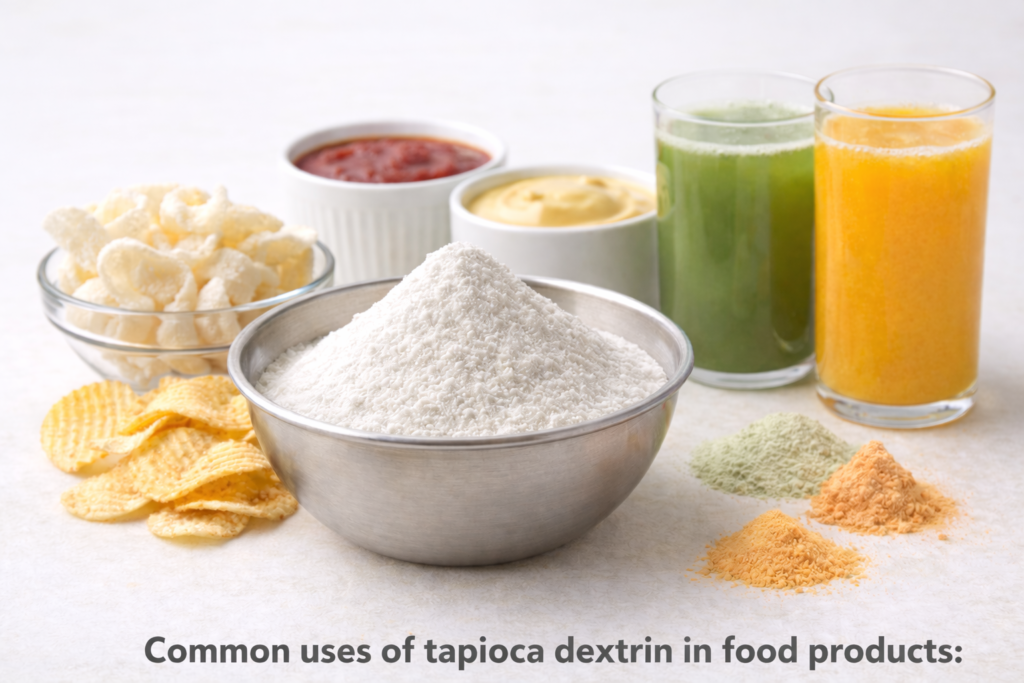
Tapioca dextrin is used in food products as a bulking agent, texture improver, fat replacer, and carrier for flavors or nutrients. It helps manufacturers reduce sugar or fat while maintaining mouthfeel and stability. Because it has a neutral taste and good processing tolerance, it is widely used in snacks, beverages, sauces, and powdered food systems.
Tapioca dextrin performs more than one function. Its value becomes clear when U see how it works across different food categories. The sections below explain these applications in detail.
1. What Is Tapioca Dextrin?
Tapioca dextrin is a modified carbohydrate made from tapioca starch. Manufacturers produce it through controlled heat or enzymatic treatment. This process changes the starch structure and improves its solubility and functionality. The final ingredient appears as a fine white powder with mild sweetness or no sweetness at all.
Tapioca dextrin is a functional carbohydrate derived from tapioca starch and used to improve food structure and processing performance.
Key Characteristics
| Property | Description |
|---|---|
| Taste | Neutral to slightly sweet |
| Solubility | Good in water |
| Stability | Heat and pH tolerant |
| Source | Tapioca (cassava) |
Tapioca dextrin blends easily with other ingredients. It works well in dry and wet systems. This flexibility makes it suitable for many food categories.
** Tapioca dextrin offers stable performance in diverse food systems.
** Its neutral taste supports broad formulation use.
2. Why Is Tapioca Dextrin Used as a Bulking Agent?
When sugar or fat is reduced, food often loses volume and body. Tapioca dextrin restores bulk without increasing sweetness. This makes it valuable in reduced-calorie and sugar-reduced foods.
Tapioca dextrin adds volume and structure when sugar or fat levels are lowered.
| Application | Function |
|---|---|
| Low-sugar snacks | Restores body |
| Sugar-free candy | Improves structure |
| Reduced-calorie bakery | Maintains volume |
It helps products feel familiar to consumers even after reformulation.
** Bulking improves consumer acceptance of low-sugar foods.
** Tapioca dextrin supports calorie reduction without texture loss.
3. How Does Tapioca Dextrin Improve Texture and Mouthfeel?
Texture strongly affects consumer preference. Tapioca dextrin smooths mouthfeel and reduces rough or watery sensations in food.
It improves smoothness and consistency without heavy thickening.
Texture Benefits
- Reduces graininess
- Adds light body
- Balances viscosity
| Product Type | Texture Role |
|---|---|
| Sauces | Smooth flow |
| Soups | Light body |
| Dairy-style foods | Creamy feel |
** Texture improvement increases product appeal.
** Light body avoids gum-like texture.
4. Can Tapioca Dextrin Replace Fat in Food Products?
Fat reduction often leads to dry or thin products. Tapioca dextrin helps restore mouthfeel and structure.
It partially replaces fat by improving body and crispness.
| Food Category | Benefit |
|---|---|
| Baked snacks | Improved crispness |
| Coatings | Reduced oil uptake |
| Processed foods | Better structure |
It supports healthier positioning while keeping sensory quality.
** Fat replacement supports healthier formulations.
** Crisp texture improves eating experience.
5. How Is Tapioca Dextrin Used in Powdered and Beverage Systems?
Powdered products require good flow and solubility. Tapioca dextrin performs well as a carrier.
It helps distribute flavors and nutrients evenly.
| Use | Function |
|---|---|
| Beverage powders | Improves solubility |
| Seasonings | Even dispersion |
| Premixes | Stable carrier |
It also supports spray-drying and encapsulation processes.
** Good flow improves processing efficiency.
** Uniform mixing improves dose accuracy.
6. Why Is Tapioca Dextrin Suitable for Clean-Label Foods?
Consumers prefer familiar and plant-based ingredients. Tapioca dextrin fits this demand.
It supports clean-label and plant-based product positioning.
Market Advantages
- Tapioca-based source
- Plant-derived
- Suitable for vegetarian and vegan products
| Trend | Benefit |
|---|---|
| Clean label | Simple sourcing |
| Plant-based | Broad consumer appeal |
** Clean-label alignment improves brand trust.
** Plant-based sourcing expands market reach.
Conclusion
Tapioca dextrin is a versatile ingredient used across many food products. It adds bulk, improves texture, supports fat reduction, and works well in powdered systems. Its neutral taste and stable performance make it suitable for modern food processing. For manufacturers, it offers a reliable solution that supports clean-label trends and product reformulation goals.
- Supports reduced-sugar and reduced-fat foods
- Improves texture and mouthfeel
- Works well in powders and beverages
- Aligns with clean-label demands
About Besty Pharma
When U need a stable supply of high-quality tapioca dextrin, working with an experienced manufacturer matters. Our factory produces tapioca dextrin under strict quality control systems and supports food manufacturers with consistent specifications and technical guidance. U gain reliable supply, professional service, and flexible solutions that support your product development goals.